
Short answer: yes. Colorado’s passenger vehicle traction law is in effect every year from Sept. 1 through May 31 on the I-70 mountain corridor between Morrison and Dotsero, whether or not it is snowing, and the Colorado Department of Transportation can activate it, or the stricter chain law, on any state highway when a storm requires it. The timing matters this week: the National Weather Service puts Denver’s average first measurable snowfall at Oct. 19, which is tomorrow. Here is what the law requires, what it costs to ignore it, and what to do if a slide on an icy on-ramp ends in a crash.
Where and when it applies
CDOT’s traction and chain law page says the traction law applies to all motorists not driving a commercial vehicle on I-70 from Morrison to Dotsero between Sept. 1 and May 31, and that it may be enforced at other times if conditions require. Outside that stretch, CDOT can implement the traction law or either chain law on any state highway during winter storms. You find out the usual ways: highway signs, COtrip.org, and the text or email alerts you can sign up for on the CDOT page. For a west-metro driver, that means the rule is already on by the time you pass the Morrison exit on a Friday afternoon headed for the hills.
What your tires need
Under the traction law, a passenger vehicle needs tires with at least 3/16 of an inch of tread that are one of three types: winter tires carrying the mountain-snowflake symbol, tires rated all weather by the manufacturer, or mud and snow tires marked M+S or M/S. A vehicle whose tires do not meet that standard must carry chains or an approved alternative traction device and put them on two or more drive tires when the law is in effect. CDOT says it strongly recommends all-wheel or four-wheel drive in the mountains when possible, but drivetrain alone does not get you off the hook. CDOT’s Winter Wise fact sheet spells it out: a 4WD or AWD vehicle qualifies only with at least 3/16 inch of tread, and the minimum tread depth was raised from 1/8 inch to 3/16 inch for all vehicles, including those with four-wheel drive.
That tread change is the part many drivers missed. CDOT announced the updated requirements in a Nov. 20, 2025 release with the Colorado State Patrol and said they took effect last fall. The same release notes that passing a snowplow running in tandem formation with its lights on is a Class A traffic offense, and cites State Patrol crash data showing that speeding on I-70 from November to March raises the chance of a crash by 2.5 percent. If you are not sure where your tread stands, our winter car checklist walks through CDOT’s quarter test and the rest of the pre-season checks.
When chains stop being optional
The passenger vehicle chain law is the next step up. CDOT implements it during severe winter storms as the final measure before a highway is closed, and when it is in effect every vehicle must have chains or an approved alternative traction device, good tires or not. Approved devices include several fabric and cable products; CDOT’s page lists examples such as AutoSock and the ISSE Tire Sock and points to its Approved Products List at apl.codot.gov for the full, current list. Buying one now, before the first closure, is cheaper than the alternative described next, and the fact sheet is blunt about that alternative: it is unlawful to proceed when a restriction is in effect and you lack the required equipment, or when a state highway is closed.
What a ticket costs
CDOT’s traction law page lists a $100 fine plus a $33 surcharge for noncompliance, and a $500 fine plus a $157 surcharge when a noncompliant vehicle causes a travel lane to close in one or more directions. The Winter Wise fact sheet gives the same fines with surcharges a dollar lower, $32 and $156, and the Nov. 2025 release quoted an older $50 plus $17 figure, so treat the page as current and budget for roughly $133 or $657. The bigger cost is the one that does not show up on the citation: a spun-out car blocking Floyd Hill on a powder day is the reason the lane-closure penalty exists.
If the slide ends in a crash
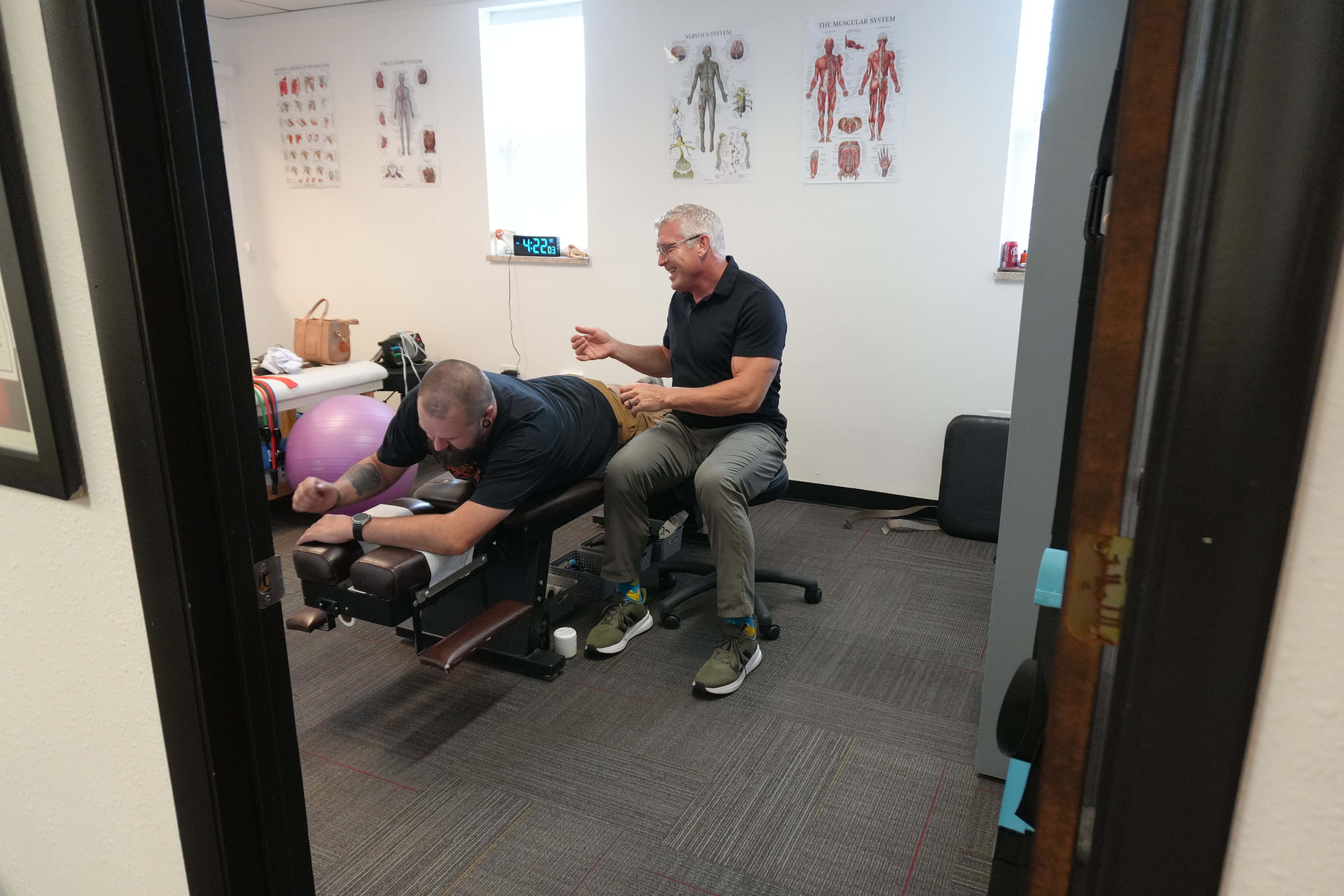
Good tires lower the odds, but the first icy mornings of the season still produce fender benders on surface streets long before anyone reaches the tunnel. Lakeside Spine and Injury Center in Wheat Ridge, a few blocks from the I-70 and Kipling interchange, published a useful explanation this month of why icy-road crashes cause different injuries than dry-pavement ones. The clinic’s point is mechanical: on ice there is usually a loss-of-control phase in which the car rotates or slides sideways before anything is hit, often followed by a second impact with a curb, guardrail or another vehicle, and drivers who see the slide coming tend to brace and grip the wheel, which sends crash forces into the shoulders, wrists and upper back. It lists whiplash with a rotational component, shoulder and wrist strain, mid-back and rib-area soft tissue injury, low back strain from curb impacts and knee bruising from the dash as the patterns it sees. Its advice is to get checked even if you feel fine, because adrenaline and cold can mask symptoms and stiffness often shows up on day two or three, and to treat numbness, weakness, a severe headache, dizziness or confusion as reasons for prompt medical evaluation. The clinic also suggests writing down what you remember about the slide, including which way the car spun and what it hit, because the mechanism guides the exam. Disclosure: Lakeside Spine and Injury Center is a Holland Health Marketing client.
The paperwork side is covered in two earlier guides: what you are required to do after a crash in Colorado, and how the $5,000 MedPay coverage on your auto policy pays for an exam like the one above regardless of who was at fault.
The short checklist
- Tread: at least 3/16 inch on every tire, including on 4WD and AWD vehicles.
- Tire type: mountain-snowflake winter tires, manufacturer-rated all-weather tires, or M+S tires. All-season tires without the M+S marking do not count.
- Otherwise: chains or an approved alternative traction device, on two or more drive tires when the law is active.
- Chain law: everyone needs chains or an approved device, no exceptions.
- Check COtrip.org or call 511 before a mountain drive, and sign up for CDOT’s traction law alerts.
Sources
- Colorado Department of Transportation: Passenger Vehicle Traction and Chain Laws; CDOT, CSP and safety partners share new Traction Law requirements (Nov. 20, 2025); Winter Wise Colorado traction law updates fact sheet
- National Weather Service, Denver/Boulder: Denver’s Fall/Winter/Spring Statistics
- Lakeside Spine and Injury Center: Winter Car Accidents in Colorado: Why Icy-Road Crashes Cause Different Injuries (Oct. 5, 2026), linked above
This is general information, not legal advice. Fines and rules can change; CDOT’s page is the current word.
More like this: Colorado News, Learn, What to keep in your car for a Colorado winter, Icy sidewalks: shoveling deadlines by city, Local Business Spotlight: Lakeside Spine and Injury Center, Wheat Ridge, Golden


