
The first cold snap along the Front Range tends to settle the argument about whether the house is drafty. One room never warms up, the furnace runs more than it should, and the first winter gas bill makes the point for you. The hard part is figuring out where the heat is going, because most of it leaves through places you cannot see: the top plate of a wall, a gap around a can light, an attic hatch, the band joist above the basement. An infrared scan is the tool that makes those places visible, and in Colorado there are a few affordable ways to get one.
What a thermal imaging scan actually shows
Thermography measures surface temperature with an infrared camera. The U.S. Department of Energy explains that energy auditors use it to detect thermal defects and air leakage: on a winter scan from inside the house, a wall section with missing insulation reads colder than the wall around it, and air leaks show up as streaks in the camera’s viewfinder. The DOE notes that interior surveys are generally more accurate because there is less air movement, and that in northern states scans are usually done in winter, when the camera has the temperature contrast it needs. Its guidance calls for a difference of at least 20 degrees between inside and outside air, which is why a scan on a 45-degree afternoon in October tells you less than one on a 20-degree morning in January.
A scan finds more than drafts. Because wet insulation conducts heat faster than dry insulation, the DOE says thermographic scans of roofs can often detect roof leaks. That matters on the Front Range after a hail season, where a roof can look fine from the ground and still be holding water under the shingles. The DOE also recommends having a scan done before buying a house, because even new houses can have defects in their thermal envelope.
What a home energy audit covers, and what it costs in Colorado
The camera is one piece of a professional home energy assessment, which the DOE calls the essential first step before spending money on upgrades. A full assessment pairs the infrared camera with a blower door, a powerful fan mounted in a doorway that depressurizes the house so the leaks exaggerate themselves and show up on the scan. The DOE’s Energy Saver fact sheet puts the cost of a professional assessment at roughly $250 to $600 or more, and it advises using a certified assessor.
Xcel Energy customers have a cheaper path. The utility’s Home Energy Squad Plus visit, booked through its program store, is listed at $100 for a limited time (regular price $150) and typically lasts three hours. It includes an inspection of the home’s exterior, insulation and mechanical systems, an air leak analysis with a blower-door test, a combustion safety test, infrared imaging and analysis, and a written summary report with recommendations, followed by free advising on upgrades and rebates. The program page notes that homes with vermiculite attic insulation or dirty wood-burning fireplaces cannot receive the air leakage analysis. The basic Home Energy Squad visit, about two hours of direct installs such as LED bulbs, weather-stripping on one exterior door and faucet aerators, is listed as free for a limited time. Both are trip fees; the installed materials are included.
Income-qualified households can skip the fee entirely. The Colorado Energy Office’s Weatherization Assistance Program provides no-cost weatherization for qualified residents, with eligibility set by county, household size and income; the energy audit is required and free, and the measures can include attic, wall and floor insulation, air sealing and furnace repair or replacement. The office warns that waiting lists are possible.
The rebate picture going into winter 2026
Two programs that paid for a lot of Colorado insulation work over the past year are not where they were. The Colorado Energy Office’s page, updated in October 2026, says Home Electrification and Appliance Rebates for single-family homes are no longer available; the office accepted applications from Nov. 13, 2025 through Aug. 1, 2026. Rebates for manufactured homes and for large multifamily buildings are listed as coming soon. The office’s federal tax credit page also states that the residential energy efficiency tax credits are not available for projects placed in service after Dec. 31, 2025, so a 2026 insulation job should not be budgeted around a federal credit. Xcel still advertises rebate advising as part of its audit visit; the current dollar amounts are on the utility’s own site and change, so ask the advisor rather than relying on a figure from a contractor’s flyer.
What to fix first
The DOE’s fact sheet makes the point most audits confirm: you may only need to air seal small gaps and add attic insulation. ENERGY STAR’s recommended insulation table, based on the 2021 International Energy Conservation Code, puts the Denver area in Climate Zone 5 and calls for an attic at R49 to R60, depending on how much insulation is already there, a floor over an unheated space at R30, R5 to R10 of insulating sheathing under new siding on an uninsulated wood-frame wall, and R15 sheathing or R19 batts on basement walls. In practice that means a 1970s ranch in Arvada or Denver with three or four inches of loose fill in the attic is well short of the target, and a thermal scan will usually show the thin spots and the gaps around the hatch before anyone climbs up to measure.
Air sealing comes before insulation, because blown insulation on top of a leaky ceiling still leaks. The scan and blower door point to the attic hatch, plumbing and wiring penetrations, recessed lights and the top plates; those get foamed or caulked first, then the attic gets topped up. Windows are usually last on the list, because replacing them costs far more per unit of heat saved than sealing the attic.
When the building is bigger than a house
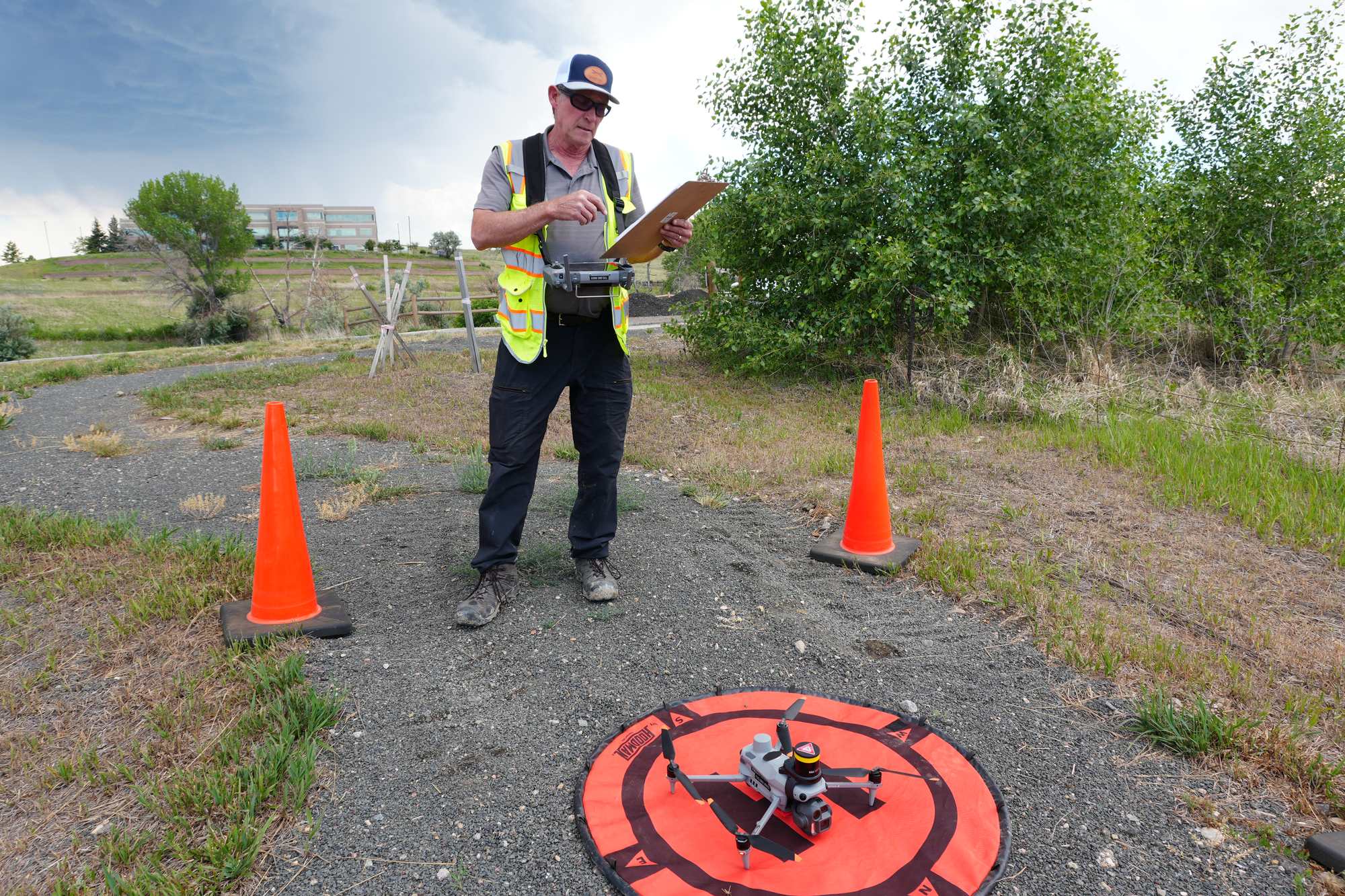
A handheld camera and a blower door work for a single-family home. For a townhome association, an apartment building, a church or a commercial roof, the same physics gets applied from the air. Dragonfly Aerials, an Arvada drone company, describes its thermal and infrared imaging service as detecting heat-loss areas in building envelopes and insulation gaps, moisture trapped in roofing systems, subfloors and parapet walls, and solar panel failures, with use cases that include energy audits for commercial buildings, post-storm roof and facade assessment and insurance documentation for moisture-related claims. A roof scan after a cold night can show a property manager where the wet insulation is before a leak reaches a ceiling, which is the same wet-insulation signal the DOE describes for homes, read across an entire roof in one flight. Disclosure: Dragonfly Aerials is a Holland Health Marketing client.
Sources
- U.S. Department of Energy, Energy Saver: Thermographic Inspections
- U.S. Department of Energy, Energy Saver: Home Energy Assessments and the Home Energy Assessments fact sheet (PDF)
- Xcel Energy Home Energy Squad Plus visit and the Home Energy Squad visit
- Colorado Energy Office: Home Energy Rebates, Weatherization Assistance Program and federal tax credits for homes
- ENERGY STAR: Recommended Home Insulation R-Values
- Dragonfly Aerials: Thermal and Infrared Imaging Services
More like this: Home + Property · Learn · Should I get my roof inspected before winter in Colorado? · Is Colorado’s traction law in effect right now? · Local Business Spotlight: Dragonfly Aerials · Arvada


