
The first cold snap shows you which rooms in your house are drafty. It does not show you why. A home energy audit does, and on the Front Range you can get a good one for somewhere between nothing and $100. What has changed this year is the help available to pay for the repairs afterward. Here is how an audit works, where to book one and what money is still on the table in fall 2026.
What a home energy audit is
The U.S. Department of Energy describes a professional home energy assessment as a room-by-room examination of the house plus a review of past utility bills. Many assessments include two tests that do the real detective work: a blower door test and a thermographic scan.
A blower door is a powerful fan mounted in an exterior doorway. It pulls air out of the house and lowers the pressure inside, so outside air rushes in through every unsealed gap and crack. That lets the auditor measure how leaky the house is and find the leaks. The Energy Department’s advice is to make sure the auditor uses a calibrated blower door, which measures leakage instead of only locating it.
What the infrared camera sees
Thermography uses an infrared camera to measure surface temperatures, and the Energy Department says it is used to find thermal defects and air leakage in a building’s envelope, the shell of walls, roof, windows and doors that separates inside from outside. Run with the blower door, air leaks show up as dark streaks on the camera.
Two details matter for Colorado. The most accurate images come when there is a large temperature difference between inside and outside air, at least 20 degrees Fahrenheit, which is why colder states generally scan in winter. And interior scans are generally more accurate than exterior ones, because wind makes temperature differences harder to read from outside. In other words, the season for a useful scan is starting now.
Where to get one on the Front Range
- Xcel Energy customers: The Home Energy Squad Plus visit is listed at $100 for a limited time, down from $150. It takes about three hours and includes a blower door test, infrared imaging, a combustion safety test and a carbon monoxide check. A shorter standard visit, without the blower door or infrared scan, is listed as free for a limited time. Homes with vermiculite attic insulation cannot get the blower door test. Call 303-446-7910.
- Fort Collins, Loveland, Longmont and Estes Park: The cities’ shared program, Efficiency Works, lists a home energy assessment at $0 to $60 and one to four hours, with a blower door test and infrared imaging. In Fort Collins, Epic Homes prices it at $60, which the city says is discounted from a $600 value, and waives the fee for income-qualified households and rental properties. Call 877-981-1888.
- Income-qualified households anywhere in Colorado: The state’s Weatherization Assistance Program provides no-cost weatherization, and the required energy audit is free. Households that receive SNAP, LEAP, SSI, TANF or Aid to the Needy Disabled may qualify automatically, and renters can take part with the owner’s permission. There can be a waiting list. Energy Resource Center handles the Denver metro area at 720-236-1321 and Northern Colorado at 970-617-2801.
What is left to help pay for the fixes
This is where 2026 differs from last year, and it is better to know before you plan a project.
- The federal tax credit is over. The IRS says the Energy Efficient Home Improvement Credit applies to improvements made through Dec. 31, 2025. Insulation or an audit paid for in 2026 does not earn it.
- The state’s largest rebate is closed for houses. The Colorado Energy Office says its HEAR rebate program for single-family homes is closed on the Front Range and in the rest of the state. It says rebates for manufactured and mobile homes and for multifamily buildings will be available in 2026 but gives no opening date.
- Utility incentives remain. Efficiency Works’ 2026 incentive sheet lists 77 cents per square foot for attic insulation, $1.16 per square foot for walls and crawl spaces, and $310 to $770 for air sealing, depending on how much the blower door reading improves. The work has to follow an assessment and be done by a listed provider. Fort Collins also offers an Epic Loan of up to $50,000, repaid on the utility bill over as long as 15 years. We could not read Xcel’s current insulation rebate amounts, so ask the Home Energy Squad advisor during your visit.
- Heat pumps still have help. Colorado’s heat pump tax credit is $1,000 for an air-source heat pump installed in 2026. The registered contractor claims it and must pass at least $333 to you as a discount. In the Denver region, Power Ahead Colorado lists a $1,500 rebate on qualifying cold-climate heat pumps and recommends weatherizing the home first, which is one more reason to start with an audit.
Cities change their own programs often, and we could not read Denver’s rebate pages today, so check your city and your utility before you sign a contract.
Commercial buildings and big roofs
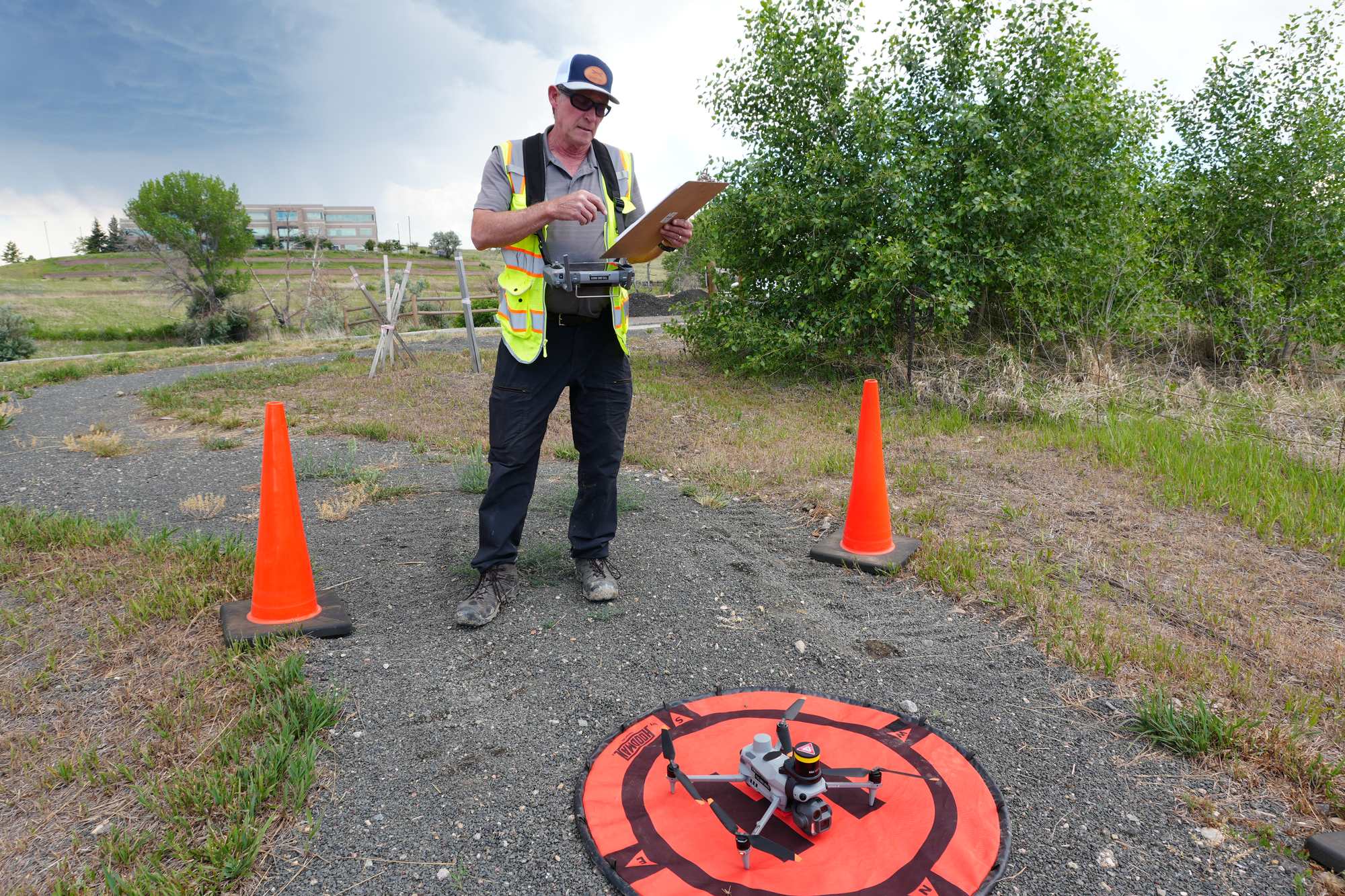
The utility visits above are built for houses. For an office, a church or an apartment complex, the same physics applies on a bigger surface, and the Energy Department notes that thermographic scans of roofs can often detect leaks, because wet insulation conducts heat faster than dry. One way to cover a large roof or a tall wall is from the air. Dragonfly Aerials, an FAA Part 107 certified drone company based in Arvada, lists heat loss in building envelopes, insulation gaps, moisture in roofing systems and energy audits for commercial buildings among the uses of its thermal and infrared drone imaging for buildings, and offers a thermal add-on with its drone roof and facade inspections. Disclosure: Dragonfly Aerials is a Holland Health Marketing client.
Before the auditor arrives
- Pull a year of energy bills. Your utility can usually provide them.
- Write down the problems you already know about: the drafty bedroom, the window that fogs with condensation.
- Book it for cold weather, and ask whether the visit includes a calibrated blower door and an infrared scan.
- For the infrared scan, move furniture away from exterior walls and take down drapes.
- If you heat with wood, make sure every fire is completely out, coals included, before a blower door test.
- Walk through the house with the auditor and ask questions as you go.
Sources
- U.S. Department of Energy, Energy Saver: Professional Home Energy Assessments, plus its pages on thermographic inspections and blower door tests
- Colorado Energy Office: Home Energy Rebate Program, Weatherization Assistance Program and Heat Pump Tax Credits
- Internal Revenue Service: Energy Efficient Home Improvement Credit
- Xcel Energy Home Energy Squad, Efficiency Works, City of Fort Collins Epic Homes and Power Ahead Colorado, linked above
- Dragonfly Aerials service pages, linked above
This is general information. Program prices and rules change, so confirm the details with the program before you spend.
More like this: Home + Property, Learn, Can a drone fly over my house in Colorado?, Icy sidewalks: shoveling deadlines by city, Watch: how to winterize your sprinklers, Local Business Spotlight: Dragonfly Aerials, Fort Collins, Arvada


